Friday, February 7, 2014

Rocketeer's Lexicon: Delta-V

Simplified Rocket Equation
So for pretty much the entire narrative of this blog I've been talking about a quality of my spacecraft called Delta-V. I don't particularly like to type delta-v, but my alt-coding is not the best so I'm not actually sure how to type the actual Greek letter I am referring to. Oh well.

Anyway, delta-V, in simple physics terms, is the amount by which a velocity has been changed. There is one such formula for Delta-V based on a steady rate of acceleration over time that every high school student ostensibly knows and which most of you have forgotten, but that is okay because I'm not referring to it ever again. Delta-V in rocketry (whether real, sci-fi, or kerbal) refers to the amount by which a spacecraft can change its delta-V if you were to expend all of the propellant which it carried. Obviously, in staged rocketry this gets more complicated than single-stage rockets which is a part of the reason I occasionally miscalculate my delta-V budget and wind up doing stupid things like Barbara.

Delta-V is actually pretty easy to calculate manually, with a few known values and a good spreadsheet to keep track of the numbers you need. Alternatively you could use a few separate instances of the calculator app built into your computer, or a mod like Flight Engineer or MechJeb, which is my usual choice.

The formula above gives the formula for Delta-V given the velocity of the exhaust (v-sub-e), and the mass ratio (mass with fuel over mass without fuel) from which you take the natural log (ln). So the natural log of the mass ratio, multiplied by the exhaust velocity, gives you your total delta-v. Nominally.

Now, that only works for a single stage, so remember not to discount the fuel in any of the stages above it when you are calculating the dry mass (m-sub-i). This is part of the reason why it is in my view better to use a program like Flight Engineer or MechJeb for doing these calculations in Kerbal Space Program.

The delta-V calculation, or Tsiolkovsky's rocket equation, is one of the single most important equations in fundamental rocketry. If you play quite a bit of KSP or want to start making model rockets or are going to work for a major space agency (or space corporation) one day, you're going to need it. Advice from the interesting website Project Rho for aspiring hard-sci-fi writers is actually to have it on a poster or t-shirt. I simply memorized it as that was far easier.

Delta-V is so important because it is fundamentally the range of your spacecraft, which is to say a map of real distances in space is actually far less useful than a delta-v map showing the required delta-v to get from point-A to point-B. Making some exceptions for nifty things like the Oberth effect and aerobreaking, your fuel-based Delta-V is going to pretty well limit where you can go and what you can do once you've gotten there. Further, it's a useful measure of range because it already took into account the mass of a craft, so the delta-V of a TDRS satellite tells you exactly as much as the Delta-V of a Star Destroyer.

So, once you've got an idea of delta-v, it's helpful to have a map of delta-V values for the sorts of places you want to go in your world. If you are kerbonaut, there is an excellent one here. Happy Flying.

Wednesday, February 5, 2014

The Hermes-Demeter Mission

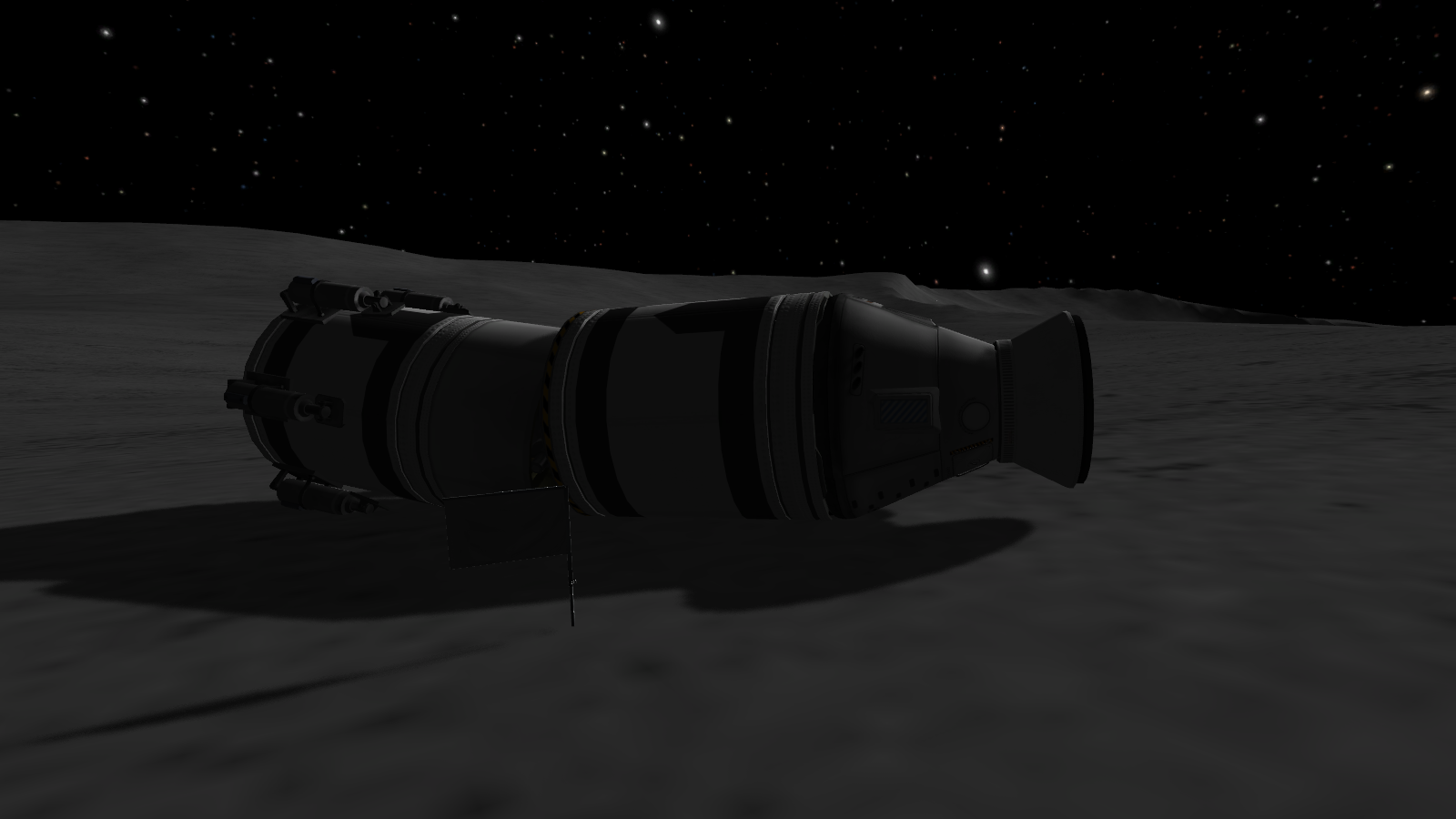
Behold Hermes.
 I actually have no idea how mission numbering would work in a NASA-style nomenclature system for the following series of missions. I do consider the whole operation to be individual missions, but at the same time, the operation itself is basically a (functionally) infinite iteration of such missions.

After the catastrophe with Barbara, it became evident we needed a new system to get the Kethane we're mining from the Munar surface to a 100 km equatorial orbit around Kerbin. True to Kerbal engineering, anyone using ten parts where fifty would do the job just isn't trying hard enough, so I changed the entire mode of operation to a two-vessel system - remote tug Hermes and remote miner Demeter.

Monday, February 3, 2014

Theseus, Barbara Return, and a Lesson in Math

Theseus on Station, Pre-Deployment
So, you may recall our last project, in which we landed a kethane workhorse on the Mun. Now that it's got a nice belly full of Kethane and reconstituted Liquid Fuel and Oxidizer reserves, it's time to bring it home.

Thursday, January 30, 2014

Luna 2: The Quest for Kethane

Luna 2: Doin' it Right.
 So, way back during the first Heinlein mission, you might recall me vaguely mentioning having brought along a probe named Luna in the nosecone of the craft.

Now, Luna was constructed using parts from the fairly popular Kethane mod for Kerbal Space Program, an add-on that adds resource gathering gameplay to the game, allowing you to essentially create fuel in-situ in a properly designed craft.

The Luna probe, with its clumsily slow Ion drive and not enough power to really run it, wasn't all that helpful in finding the kethane from orbit, since its orbit wasn't very efficient. If you want to scan the whole surface of a body, orbit it pole-to-pole. As it rotates underneath you, your flight path moves across the surface, and after a number of revolutions you'll have pretty well mapped the whole thing.
Barbara on the Richeleau Heavy

Heinlein II: The Jeb-Squared Law

Rebels without a Clue
 When last we left our intrepid crew of Bertred, Dunmore, and Huddrin Kerman on the surface of the Mun, their Heinlein I landing vehicle had toppled over under the force of a gratuitously fast landing combined with an impractically top-heavy landing stage design. Stranded on the Mun with no help of repairing their broken, battered spacecraft, there can be no other help for these heroes than for the brave astronauts that follow them to be their saviours - even when they themselves failed the task!

Tuesday, January 28, 2014

The Heinlein Mission to the Mun

The 83-m Heinlein System
 Pretty much anyone who was born before me and who had an enjoyment of Science Fiction is going to recall an author by the name of Richard A. Heinlein, who in his heighday was one of the most revolutionary writers in the field, and from whom we derive the fantastic spacer adage "Once you're in orbit you're halfway to anywhere."

What Heinlein meant by this is that the single most onerous task in space travel in terms of the fuel required is breaking into orbit around a planet - such as what we do on almost every single flight, breaking orbit of Kerbin. The "burn" for this maneuver requires a delta-v of 4550 m/s, which can be quite a bit to squeeze out and is usually the largest burn on any mission.
Third boosting stage.

Heinlein favoured the moon in his writings, and I thought that today, instead of more fiddling with sattellites, it might be fun to launch a mission to the Mun. Credit being where it was do, Toddicus decided the name of the ship for me, and all this preamble about Heinlein has very little to do with anything related.

The rocket ascended rather well, powered by four titanic solid rocket boosters and two seprate liquid-fuelled rocket boost stages. In fact, thanks to having sat done to do the math beforehand, the initial maneuvering went very quickly.
 Getting a capture window I actually liked took a bit longer. I had the bare minimum amounts of delta-v required for the mission, mostly because the ship's double-payload was probably a bit over-ambitiously heavy, and I didn't want to resort to asperagus staging to get the damn thing into orbit if I could absolutely avoid it.

One you have a window though, it's as simple as pointing the rocket onto the maneuver prograde node and burning when it tells you to. Getting to the Mun is not really an achievement compared to some of the further-out missions.
Coasting in the void, farings deployed.

Sunrise and Farewell.
Why two payloads? The short answer was that I could. The longer answer is in parts - I'd never delivered a two-part payload to the Mun before and I wanted to see if it could be done at all - it can. I also have ambitions for the moon in keeping with Heinlein, namely the production of fuel from Kethane, because shipping that fuel from the moon to a low kerbin orbit would still be cheaper than flying it up from the surface of the planet itself. Physics hates space travel.

Luna spreads her wings ahead of Heinlein
So, the second part of the payload is actually a sattelite the astronauts are going to dump into Low Munar Orbit once they get there, ideally at about 14 KM. Now, this is a bit low for groundscan, but the sattelite itself has no propulsion system of any real utility, so I had to circularize the lander and the satellite in one shot. A future mission may be planned to push the process a bit further, if I can't make some adjustments with what little fuel the probe itself has.

So, with solar collectors unfurled and the burn complete, there was little to do other than to time accelerate and coast onward, but not without first taking some pretty pictures.

In orbit of Mun, post-separation
Very unfortunately, the taking of pretty pictures did not extend so far as watching the separation of Luna and Heinlein proper, since I wasn't expecting the sheer force that my decoupler was going to impart upon the satellite. I'm reasonably certain that the faring base has a decoupler pre-installed, which might save some effort on future flights.

I was actually pleasantly surprised that we made it to the moon with as much fuel as we did. I was always planning to kill the velocity on the landing stage with the same stage I used for the transfer and capture burns, but I wound up with something on the order of a third of a tank - the equivalent of a couple hundred extra meters per second of delta-v.

De-Orbit Burn, as scheduled.
What followed later was the usual space travel trope - a good ten minutes of boredom followed by a moment of sheer terror for the crew and a proper laugh for me, here related in the form of a proper story.

"Luna is away." Danburry, the Payload specialist, commented dryly for the benefit of the flight data recorder. "TLM is all good. Solar cells to full power, streaming kethane sensor data to KSC via Athos."
Inches from the surface

Flight Commander Hilbert Kerman nodded slightly, sucking a bit of overly-dry air through his helmet filters. "Roger. Rotate through one-eight-zero yaw... complete. De-orbit burn in three, two, one..."

Well, now what?
The de-orbit burn went smoothly - taken a bit longer than originally planned. Working purely on the fly, Hilbert had calculated that the remaining fuel on board was simply going to be too heavy, and would cause the landing legs to collapse under the force of the impact at the projected landing speed.

"Moving sideways a little faster than I would like," he muttered. There was only so much he could angle sideways while burning - the landing stage only had one thruster! Still, the overall surface speed was well within the calculated tolerances of the landing legs. 100m to go, then 50, then 25...

It suddenly hit home that Hilbert was to be the first kerbal to ever walk upon the Mun. He grip the steering mechanisms with a bit more anticipation than a moment ago, cutting out the fuel feed to the landing stage rocket motor.

There was a horrendous crash and a bang, a great roar of rent metal, and the whole ship was suddenly going ass over teakettle as the rocket nozzle dragged across the ground, tearing it from the ship which landed sideways with a vast impact.


Hilbert laughed a moment later, once a very agitated Samdred Kerman got done checking through his life systems. "They send up a ship with no damn ground clearance and we hit the one rock on the whole Mun!"

Now, there is some good news in this whole process. As near as I can tell the return stage and crew capsule weren't actually damaged, and I happen to be on a bit of an incline. I think there's enough torque in the system that I could potentially take off on an angle... with a perfect transfer orbit and generous aerobreaking on kerbin, there's no reason it wouldn't work.

We might try that next time, since they have no way of calling for a rescue mission.


Friday, January 24, 2014

Project ASARTES, Part 2: Conclusion, or, "Stationary".

Maneuver nodes take the guesswork out. Sorta.
 So, when we left off, we had an elliptical and highly eccentric orbit courtesy of my sloppy insertion burn. The first thing I did was say "Okay, Let's Circularize!".

Easiest way to make any change to orbit in the vanilla GUI is to use maneuver nodes. Since I haven't quite caved in to using MechJeb yet, I grabbed a node at apoapsis and plotted out the yellow orbit in the image on the left.

Then, I accidentally clicked space, giving us the present situation you see in the image, where my maneuver isn't actually on orbit. Whoops. I then time accellerated to get up there, whipped myself around so fast the probe batteries died, and had to reload the save. Hah.
Aramis under sail - Richeleu is "falling" away.

After about ten minutes of Ion Drive. Middle line is a debris.
Service Established!
 Oh well. Such things as these happened. What isn't shown is the three attempts of me playing with different orbit plans until I got the ship in a workable position, or the separation of Aramis from the carrier vehicle.

Once we got up there, though, I had the foresight to grab an image of Aramis burning under its nifty ionic engine - this thing takes some high voltage and uses it to accelerate Xenon ions at high speed. This I like, because the fuel lasts virtually forever, affording tons of Delta-V to the person willing to wait long enough for it to add up.

It was at around that point that I realized Richeleau wasn't going to de-orbit the way it is meant to. However, because I could EASILY have used more ion drive and less chemical rocket in the orbit, I reasoned it wasn't that unreasonable to imagine I had done so, and manually truncated it from the control center.
Space after we "correct" Richeleau
After another twenty minutes of play (comprising about a full day of Kerbin time), I more or-less circularized in KEO. I say more or less because it's not perfect... it is, however, close enough for our purposes, within about 10 km altitude on either side. As long as the ships themselves are properly in phase, it won't really matter anyway - one will always be in view of ground control.

So, for purely roleplaying purposes that have no point since SAS doesn't apply once you leave the perspective of the ship, I pointed Aramis at Kerbin and popped the antenna.

Then, off we went to the space centre to trim out the things that aren't meant to be in orbit.

The final orbit wouldn't naturally degrade. Woops.
Which brings me to the next problem I had. KEO isn't really exciting to shoot. I mean it was fun to do - way more fun than my usual attempts to just get to orbit with way too much kit. I won't be showing the other launches. It's just too tedious. To be honest, I'm going to cheat them into place using the in-game debug menu, and put them into place with the much faster chemical rockets. I know it's a little silly, but I don't want to spend another hour getting them all aligned correctly.

Next: What exactly did we need our own TDRS system for, anyway?